
Introduction: Why Margaret Atwood Matters for Adult Fantasy Readers
Have you ever judged a book by its genre label? I know I have. You see "literary fiction" on the shelf and assume it will be too slow for an adventure lover like you. But here is the secret. Some of the best worldbuilding hides outside the fantasy section. If you have been craving mature stories with real depth, you need to look closer at Margaret Atwood books.
Atwood calls her work speculative fiction. She says it deals with things that could really happen. This gives her stories a grounded, terrifying, and completely absorbing feel. Her worlds are so rich they rival any epic fantasy series.
If you love stories with real emotional honesty, you might enjoy the raw human insights found in Brené Brown books. Atwood delivers that same deep look at human nature, but she wraps it in a gripping, fantastical plot. She writes for adults. Her characters face complex challenges. Her themes ask hard questions about power and survival.
Maybe you are the type of reader who loves tracking a huge universe. Perhaps you have read all the RA Salvatore books in order. Atwood offers a similar thrill. Her novels connect in surprising ways. Each book adds a new piece to the puzzle. Reading her feels like experiencing a black swan book unexpected and world changing. She brings the same fresh voice as modern fantasy authors like Jen Jenivive, but with decades of mastery behind her.
Many adult fantasy readers overlook her work because of those tricky genre labels. That is a mistake. This guide helps you fix that. We curated the best Margaret Atwood books for adult fantasy readers. We explain what makes her special. And we help you start your reading journey today.
If you are ready to read something weird, meaningful, and totally fresh, start a funny sci-fi series with identity, perspective, and chaos. It is the perfect next step for a curious reader.
The Evolution of Atwood’s Speculative Fiction: From Dystopia to Fantasy-Adjacent
So you have heard of The Handmaid’s Tale. Maybe you have even seen the show. That book is famous for a reason. It paints a scary picture of a world that feels a little too real. But here is the thing. Margaret Atwood books are not just one thing. Her writing has grown and changed over time. It moved from straight dystopia into something much bigger. Something fantasy readers can really sink their teeth into.
Atwood calls her work speculative fiction. She says it deals with things that could really happen. In an interview, she explained that speculative fiction explores the consequences of new technologies by showing them as fully operational. This grounded feeling makes her early work hit hard. It feels possible.
Now let us talk about the MaddAddam trilogy. This is where Atwood starts to blend genres in a big way. You get a plague that wipes out most of humanity. You get genetically engineered creatures like the pigoon. You get survivors trying to build a new world from scratch. It has the worldbuilding of a great epic fantasy. It has the moral questions of the best sci-fi. And it has a dark, sharp sense of humor. Adult fantasy readers who love tracking a huge universe (like those reading RA Salvatore books in order) will find a similar thrill here.
Atwood even made up a word for what she does. She calls it ustopia. It is a mix of utopia and dystopia. She believes every utopia has a hidden dystopia inside it. That complexity is exactly what adult fantasy readers crave.
If you love stories that mix genres and ask big questions, you should explore our list of the greatest books of all time for adult fantasy readers. Her work proves that a story does not need to fit in a neat box to be amazing. It can be weird, funny, and dark all at once.
This evolution makes her the perfect author for anyone looking to read something weirdly meaningful. Start a funny sci-fi series with identity, perspective, and chaos.
Why Fantasy Readers Love Margaret Atwood: Mature Themes and World-Building
Here is the thing about fantasy fans. You have read enough chosen one stories. You have seen the battle between pure good and pure evil play out a hundred times. What you really want is something messier. Something that feels real, even when it is not real at all.
That is exactly what Margaret Atwood books give you.
Atwood builds worlds around power. Who has it. Who does not. How people fight for it, lose it, and abuse it. An analysis of her stories shows that a frequent theme is the power struggle between men and women. This is not just political. It is personal. It gets under your skin the same way the best epic fantasy does when two houses clash over a throne.
Her characters are not heroes or villains. They are people trying to survive in broken systems. In The Handmaid’s Tale, Offred is no warrior queen. She is scared, tired, and compromised. That is what makes her story so powerful. Atwood shows us that legally controlling women’s reproductive freedom is morally wrong, but she does it through one woman’s small, quiet acts of resistance. That feels more true than any grand battle.
For adult fantasy readers who love complex worlds, Atwood delivers the same depth. The MaddAddam trilogy has corporations that act like kingdoms. It has bio-engineered creatures that feel like magical beasts. It has survivors who form their own tribes. If you enjoy tracking politics and factions in a sprawling series like the Dune universe, you will love unraveling Atwood’s layered societies.
She also refuses to give you easy answers. Her protagonists make bad choices. They lie. They hurt people. This moral gray area is exactly what adult fantasy readers crave.

It treats you like a grown-up who can handle complexity.
If you are ready for a story that respects your intelligence while keeping you hooked, start with something weirdly meaningful. Read Something Weirdly Meaningful
Essential Margaret Atwood Novels for Mature Fantasy Fans
If you are ready to move from understanding Atwood’s style to actually reading her work, here are three novels that will hit the spot for adult fantasy fans.
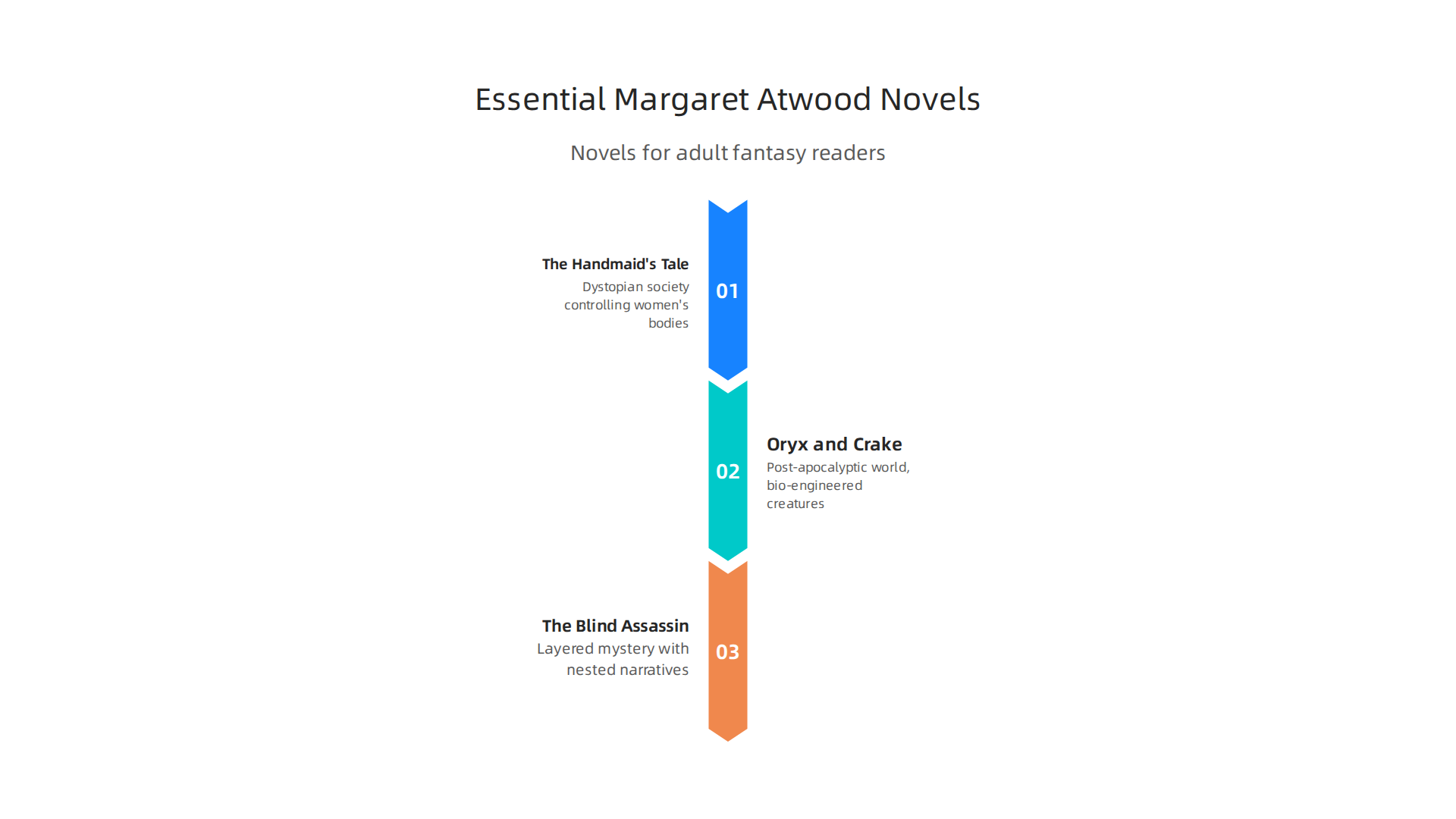
Each one offers the kind of deep world-building and moral complexity you already love in your favorite fantasy series.
The Handmaid’s Tale
This is Atwood’s most famous book for good reason. The world of Gilead feels eerily real. It is a dystopian society built on controlling women’s bodies and erasing their rights. For fantasy readers, this world-building is as rich as any fictional kingdom. You can trace the political factions, the religious rules, and the daily survival tactics of the people trapped inside.
The novel argues that legally controlling women’s reproductive freedom is morally wrong, and it does this through Offred’s personal story. She is not a warrior. She is a woman trying to hold onto her identity in a system designed to erase it. If you love tracking power dynamics in epic fantasy, this book will grip you. Think of it as a dark political fantasy where the magic is missing but the oppression is all too real.
Oryx and Crake
This is the first book in Atwood’s MaddAddam trilogy, and it is perfect for fantasy fans who love post-apocalyptic settings. The story is set in a world wrecked by a man-made plague. Survivors live in a strange, overgrown landscape filled with bio-engineered creatures that feel like fantasy monsters.
What makes this book special for mature readers is the way Atwood explores identity, freedom, and environmental degradation. The main character, Snowman, is lonely, broken, and haunted by his past. He is no hero. He is just a guy trying to survive. For fans of epic fantasy like the Dune universe, this trilogy delivers the same level of detailed world-building and political intrigue.
The Blind Assassin
This one is a little different. It is a story within a story within a story. Atwood uses nested narratives to create a layered mystery that unfolds slowly. There is a novel inside the novel that tells a sci-fi fantasy tale about a blind assassin on a distant planet. That fantasy layer mirrors the real-world drama of the main characters.
If you love stories that play with structure and keep you guessing, this is for you. It treats you like a smart reader who can handle complex timelines and multiple voices. The fantasy elements inside the story feel like a secret reward for paying attention.
These three novels show why margaret atwood books belong on every adult fantasy reader’s shelf. They offer the depth you crave.
If these heavy themes feel like a lot, that is okay. Sometimes you need a break from grim worlds. Need a Break From Grim Fantasy?
Thematic Depth: Mature Issues in Atwood’s Speculative Universe
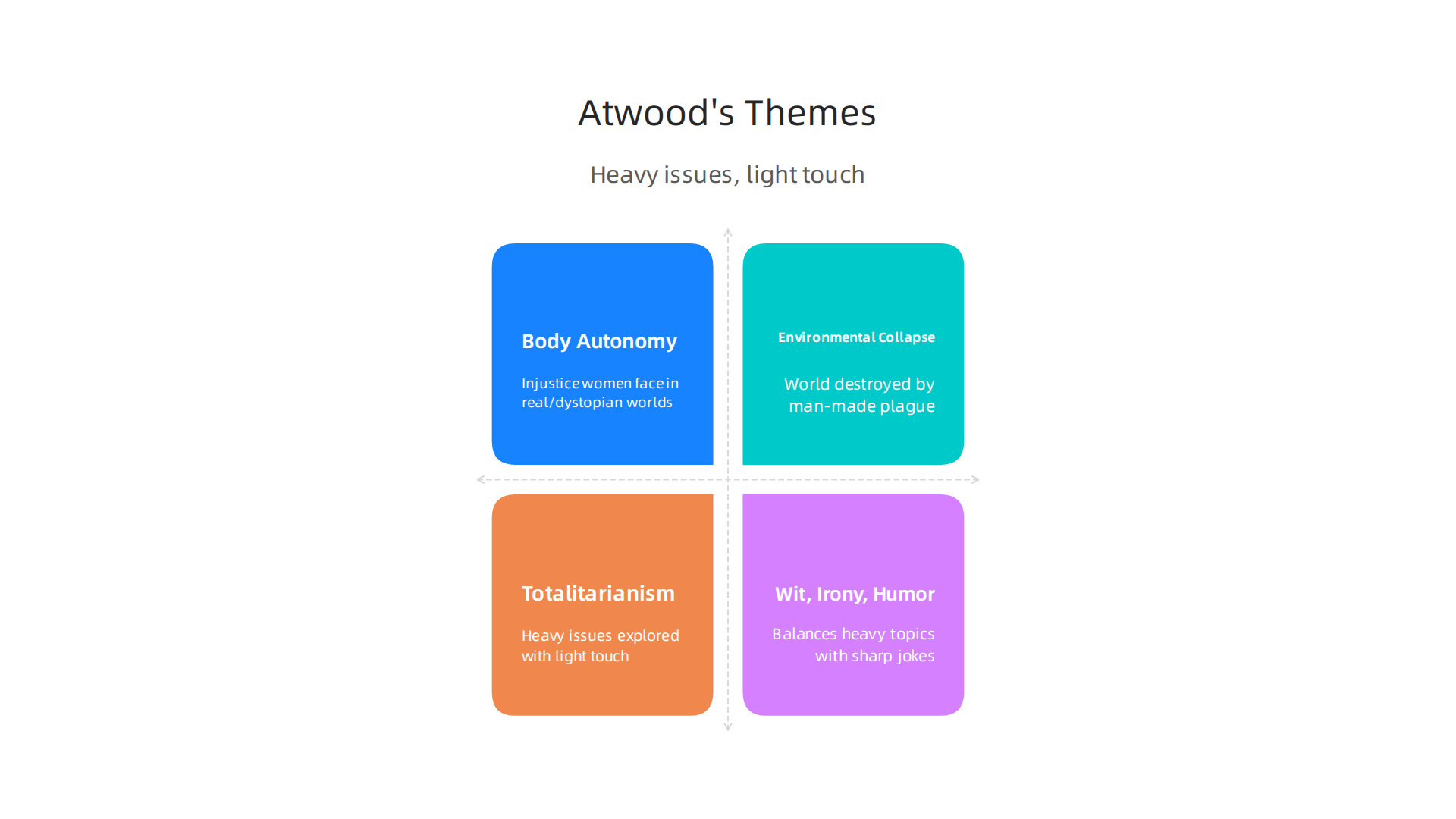
If you are an adult fantasy reader, you know the best stories do more than entertain. They make you think. That is exactly what you get with margaret atwood books. She dives into heavy issues like body autonomy, environmental collapse, and totalitarianism. But she does it with a light touch.
You never feel like she is preaching at you.
Take body autonomy, for example. Atwood often explores the injustice that women face in both real and dystopian worlds. In The Handmaid’s Tale, the entire plot is about controlling women’s bodies. It is uncomfortable to read. That is the point. She wants you to reflect on real-world issues without hiding from the truth. The same goes for motherhood. In her short story collection Old Babes in the Wood, she tackles the hot topic of motherhood in creative, surprising ways.
Environmental collapse is another big theme. In Oryx and Crake, she shows a world destroyed by a man-made plague and genetic experiments. It feels like a dark fantasy landscape. But behind the strange creatures and poisoned rivers is a warning about real environmental damage. Atwood does not scream at you. She just shows you what could happen.
Now, you might think all this darkness would be a downer. But here is the thing. Atwood balances heavy topics with wit, irony, and dark humor. Even in the bleakest moments, there is a sharp joke or a sarcastic observation. That makes her books feel human. You can laugh while you think.
If you want more stories that mix depth with strange worlds, try Read Something Weirdly Meaningful. It is a funny sci-fi series that plays with identity and chaos. Perfect when you need a break from heavy themes.
For more authors who tackle mature issues with skill, check out our guide to classic literature for adult fantasy readers.
Atwood’s Impact on Modern Dystopian and Fantasy Writing
Atwood did not just write great books. She changed the rules of the game. Today, many of the best dystopian and feminist fantasy authors openly say she is a major influence. She showed them that a story can be thrilling and smart at the same time. It can have high stakes and high intelligence.

Atwood helped kill the old idea that serious literature and genre fiction cannot mix. She calls her work "speculative fiction" rather than sci-fi. This small move opened a huge door for other writers. Now, genre-blending is everywhere. You can find literary horror, fantasy satire, and sci-fi romance on the same shelf. Atwood made that possible. The "Atwoodian" style is now a real thing. It means sharp, satirical stories that still feel deeply human. She looks at the darkest parts of society but never forgets the people inside the system.
She also tackled taboo topics head-on. She wrote about uncomfortable topics like consensual and non-consensual power dynamics not for shock value, but to make a point. This bravery gave permission to a whole generation of writers to explore uncomfortable truths.
This influence has created a rich landscape for readers like you. If you love the deep emotional honesty in Brene Brown books, you will see a similar courage in Atwood. If you enjoy the intricate plotting you find when tracking R.A. Salvatore books in order, Atwood offers a different kind of architecture. She builds societies. She builds systems. And then she watches her characters try to survive inside them. Authors like Jen Jenivive books represent the new wave of speculative writers. They mix deep character work with wild, imaginative worlds. They are writing the kinds of stories Atwood made room for.
If you are ready for more stories that take risks and blend genres, check out Read Something Weirdly Meaningful. It is a funny sci-fi series with sharp ideas and a chaotic heart. It is proof that Atwood’s influence is alive and well in 2026.
For more authors who break the rules and write timeless stories, see our guide to classic literature for adult fantasy readers.
A Closer Look at The Handmaid’s Tale and Its Fantasy Elements
Here is the thing about The Handmaid’s Tale. If you strip away the modern setting, the world of Gilead looks a lot like a fantasy kingdom. It has strict social ranks, ancient rituals, and a survival story that feels epic.
Atwood built Gilead with the same care a fantasy author uses to build a magical realm. The society has a detailed hierarchy. At the top, the Commanders hold power. Then come the Wives, the Aunts, and the Marthas.
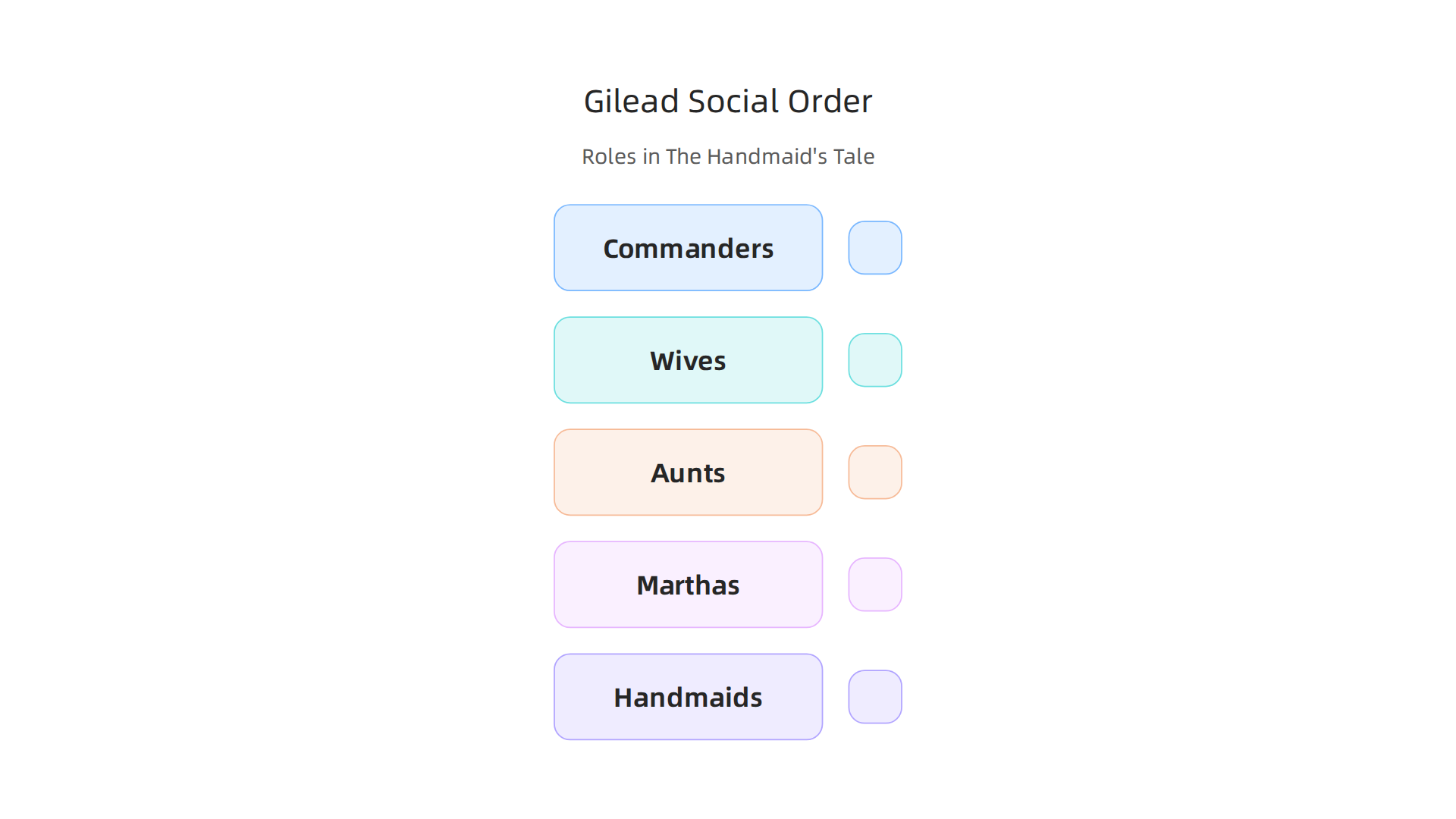
At the bottom are the Handmaids. These are fertile women forced to bear children for the ruling class. As this TV Tropes entry explains, a woman becomes a Handmaid if she has done something the government sees as sinful. The rules are brutal and precise.
Fans of epic fantasy will appreciate the deep world-building. Atwood uses key dystopian elements like oppressive government control and restricted freedoms. Sound familiar? It should. This is the same kind of system you see in dark fantasy novels. The difference is that Atwood kept everything believable. She did not use magic. She used laws, religion, and fear.
The story follows Offred, a Handmaid trying to survive. Her journey is a survival narrative, much like a hero escaping a dark empire. The SparkNotes analysis of the novel’s themes highlights how the book argues that controlling women’s reproductive freedom is wrong. That is a political idea. But the way it plays out feels like a dark fantasy ritual.
If you love the kind of intricate world-building you find in complex series, you will see a similar genius here. Authors like Jen Jenivive books carry this tradition forward. They blend deep character work with imaginative systems.
For more stories that explore dark power structures and survival, check out our guide to Shirley Jackson books. Both authors understand the same thing. The scariest systems are the ones that feel real.
If you want a funny, chaotic take on survival in a weird world, start Read Something Weirdly Meaningful. It proves Atwood’s influence is alive and well in 2026.
The MaddAddam Trilogy: Sci-Fi or Epic Fantasy?
If The Handmaid’s Tale traps you in a single house, the MaddAddam trilogy drops you into a world that has already ended. A plague has wiped out almost everyone. The survivors must figure out how to live again.
Atwood populates this broken world with genetically engineered creatures, corporate cults, and desperate humans. She uses speculative biology and sharp satire to build a place that feels as strange and complete as any fantasy kingdom you have visited.
This trilogy runs on the same engine as epic fantasy: creation, destruction, and rebirth. You see the cycle play out across the books. It makes you think about what we are building right now.
Atwood tackles deep moral questions here. That is why critics often focus on how her work explores survival and power, as seen in analysis of her major themes. She does not use magic, but the result feels just as mythic.
If you enjoy authors like RA Salvatore or Jen Jenivive, you will appreciate how Atwood builds a world from scratch. She uses science and human nature instead of spells. It is a different kind of wonder.
The trilogy shows the full range of margaret atwood books. She moves easily between genres while keeping her sharp voice. For a lighter look at survival and strange communities, pick up this smart and funny sci-fi story. It proves deep ideas can also be a lot of fun.
Where to Start: A Reading Journey for Fantasy Fans New to Atwood
If you are used to epic world building from authors like RA Salvatore, jumping into Atwood can feel a little strange at first.
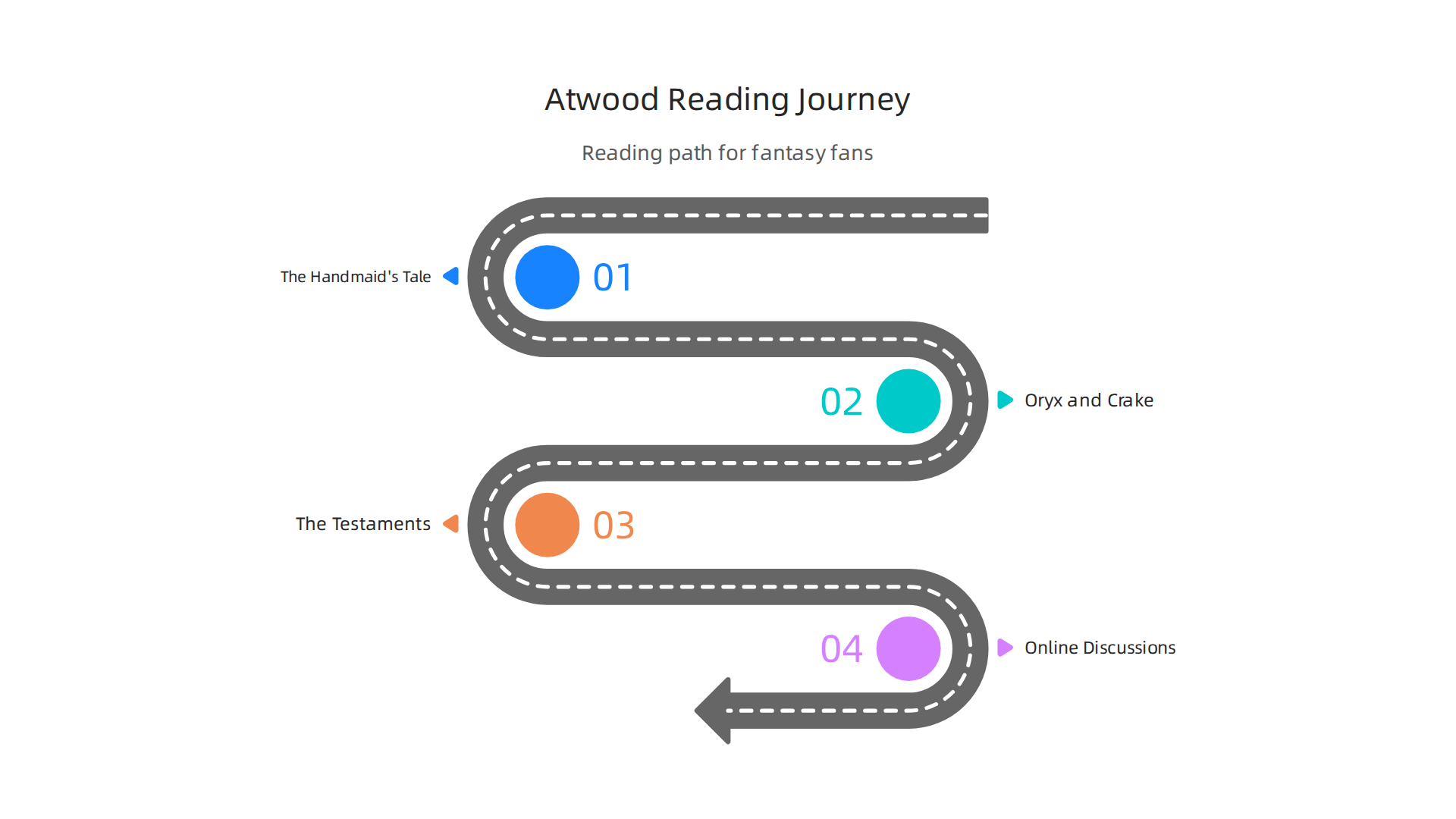
But here is the good news. You do not need to read chronologically. Many readers recommend a different path.
Start with The Handmaid’s Tale. It is her most famous book for good reason. The world building is tight and immediate. You learn the rules of Gilead alongside the narrator. The stakes feel personal and real. Many reading guides suggest this as the first stop for new readers. It is an easy gateway into the style of margaret atwood books.
After that, jump to Oryx and Crake. This is where fantasy fans really feel at home. The world has already collapsed. Atwood gives you a bigger canvas with strange creatures, dark humor, and moral puzzles. It feels closer to the epic scope you love. In fact, several ranking lists place the MaddAddam books among her best work.
If you want an even easier on ramp, try The Testaments. It is a direct sequel to The Handmaid’s Tale with multiple narrators. Some essential reading guides call it the best choice for first time readers because the pace moves quickly.
You can also join online discussion groups as you read. Talking about Atwood with others makes the experience richer. Fans share theories about her symbols and hidden meanings. It helps you see the depth you might miss alone.
For readers who enjoy finding adult fantasy books for mature readers, Atwood offers the same thematic weight with a different tool kit. She uses science and social critique instead of magic.
When you need a lighter break after all that weight, try a smart and funny sci-fi story that still respects your intelligence. It proves you can have deep ideas and a good laugh at the same time.
Summary
This article argues that Margaret Atwood—often labeled a literary or speculative fiction writer—deserves a place on adult fantasy readers’ bookshelves because her work delivers worldbuilding, moral complexity, and vivid societies that rival traditional epic fantasy. It explains how Atwood’s style evolved from stark dystopia into genre-blending novels like the MaddAddam trilogy that feel mythic without magic, and it shows why themes such as power, body autonomy, and environmental collapse resonate with fantasy fans. The guide highlights three essential novels (The Handmaid’s Tale, Oryx and Crake, The Blind Assassin), compares her approach to long-form fantasy worldbuilding, and suggests a practical reading path for newcomers. It also discusses Atwood’s influence on modern speculative and feminist fiction and how her sharp satire and moral ambiguity create the kind of mature, messy stories many fantasy readers crave. Readers will finish the piece knowing which books to try first, what to expect from Atwood’s worlds, and why her work matters to anyone who loves deep, adult-oriented fiction.